

Summary
The Defence Investment Plan (DIP) commits £298 billion to 2029/30. It is a procurement pipeline that provides clues about which regions could play a role, but it is not a regionally specific investment map. The explicitly place-based commitments were set out in the Defence Industrial Strategy with around £432 million, or 0.15% of the envelope allocated to specific areas. The DIP is the more important document, but economic development practitioners need to read between the lines. There is a large regional prize to be secured, although the international evidence on how to achieve it is consistent. Value accrues to the places that engineer the link between the secured contracts and the local economy, not to those that assume it.
Two documents, two jobs and only one carries the geography
The Ministry of Defence published its Defence Investment Plan on 30 June 2026, backed by £298 billion over four financial years to 2029/30, with total defence spending expected to approach £80 billion a year by 2029. Of course, the key question for economic development professionals up and down the country was left to reflect on what that might mean for their economy.
Two documents are routinely conflated in the answer. The Defence Industrial Strategy (2025) is the growth document. It names places, commits £250 million to Defence Growth Deals and £182 million to skills, and identifies twelve regions with high-growth cluster potential. The Defence Investment Plan is the capability document — munitions and energetics, combat air, submarines, space, software-defined capability. It carries no geography at all but the suppliers who win these contracts will also have the potential to drive the economy of the region – if the region is ready to support the work.
Read properly, the DIP is therefore a procurement pipeline with a geography implied but not stated.
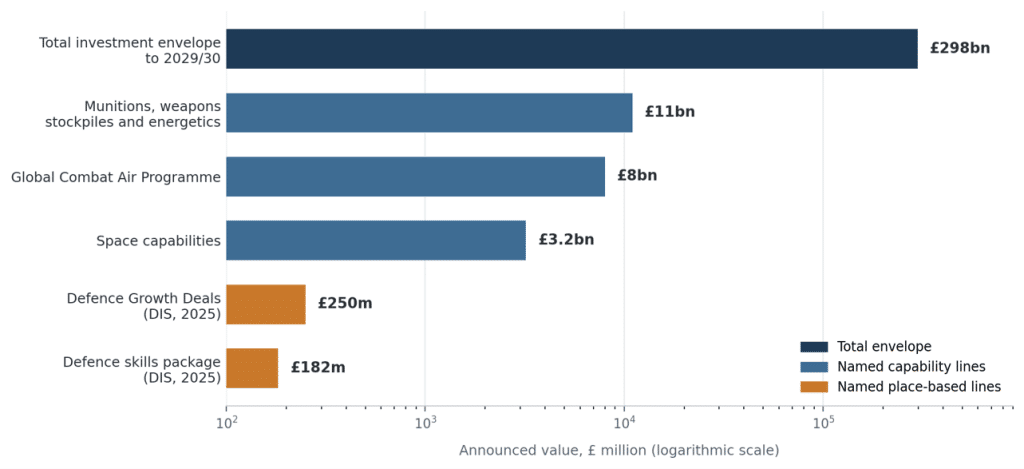
Figure 1: Announced commitments, capability versus place. Logarithmic scale.
Sixty years of evidence from Barrow
Barrow-in-Furness has built Britain’s nuclear submarines for more than sixty years. It is, on paper, precisely the industrial hub that defence-led regeneration is supposed to produce. Yet as Professor Al Rainnie and others have argued — pointedly, within the Australian debate about AUKUS — Barrow has continued to record below-average wages and low educational attainment, with the yard functioning as something close to an enclave. The phrase used is “cathedral in the desert”.
Whether one accepts the characterisation in full, the underlying point is sound. A large defence prime is not, in itself, a regional development programme. The connection between a major contract and a broader local economy has to be deliberately engineered. Where it is not engineered, it does not happen by itself. Sixty years is a compelling sample size.
What deliberate engineering looks like
Within this debate, three international comparators are interesting, and the variable that distinguishes them is institutional rather than financial.
Table 1: Four defence-anchored economies
| Place | Anchor and scale | What was built around it |
| Barrow-in-Furness, UK | Submarine construction, 60+ years | Little, until recently. The partnership structure lately mobilised there is now the model for the Defence Growth Deals |
| Huntsville, Alabama | Redstone Arsenal and NASA Marshall; c. 90,000 jobs; over half of Tennessee Valley gross regional product | Cummings Research Park, the second-largest in the United States, with universities, community colleges, and accelerators embedded within it. Huntsville also chose its sector strategy: systems integration, not semiconductor fabrication |
| Kongsberg, Norway | Advanced technology cluster since 1814, in a town of modest size | Dual-use discipline. Sensors, underwater technology, autonomy and satellites sold into defence, maritime and space at once; maritime has been the larger business for much of recent history |
| Osborne, South Australia | At least A$30bn under AUKUS; workforce approaching 10,000 | A proposed State Development Area, an Office of the Coordinator General, an A$500m+ skills academy on the yard site, and a university campus simulating a working yard |
- Huntsville: the anchors did not build the pipelines. Coherence between federal demand, industry, tiered education and coordinated economic development did.
- Kongsberg: defence did not create the cluster. Transferable technology did, and defence was one of several markets.
- Osborne: the outcome is genuinely open, the Barrow critique is being levelled at it in real time, but nobody could accuse South Australia of assuming the benefits would arrive of their own accord.
Where that leaves UK regions
For most areas, the realistic prize is supply chain participation and a dual-use technology base, both of which are shaped by constraints visible long before any contract is awarded.
In some cases, the need to separate defence facilities to address physical danger and security creates a requirement for space that few UK local authority employment land allocations can accommodate. Further considerations for some types of occupier also include ensuring grid connection dates, providing test airspace, and delivering a cleared labour pool narrowed by nationality and residency requirements that standard labour market analysis will not reveal.
The firms best placed to grow from major contracts are therefore often existing players in existing locations and also ‘adjacent capable’ players (such as automotive, nuclear, precision engineering, industrial software businesses) who are currently held back by accreditation issues rather than awareness of the opportunity.
Nevertheless, the increased expectation of a locally based supply chain is likely to lead to very significant lower-tier supply chain opportunities and inbound investment, and it is this that carries the potential for regional economies even where they may have hitherto considered the opportunity to be someone else's prize.
There is a discipline required to determine whether different types of opportunity are relevant to different labour markets. In a local economy already close to full employment in engineering occupations, a defence expansion will substantially reallocate skilled labour rather than create it, and this can simply create problems for the indigenous manufacturing base. This is another reason to revisit whether the sector can create a new opportunity for the area.
The opportunity is real and unusually long-term, which is rare in economic development. But it will accrue to the places that have done the analytical and institutional work in advance, and to a considerably lesser extent to those that publish a defence prospectus and wait.
Mickledore supports local authorities, combined authorities and their partners with sector and supply chain analysis, economic impact assessment and business case development. We have undertaken defence and advanced manufacturing cluster work for clients across the UK, and would be glad to discuss how the current investment picture translates into a credible proposition for your area. Contact nwilcock@regionaldevelopment.co.uk